The viral math trick that’s blowing up the internet… Is the answer really 6? Find out in the first comment ⬇️
The equation that’s causing a stir in the comments
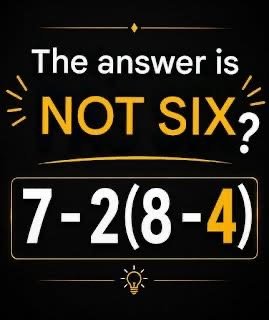
It all starts with a seemingly innocuous operation: 7 − 2(8 − 4)
The result? Some answer 6 , others 20 , and a few confidently assert that it’s -1 . Not to mention the caption that often accompanies the image: “The answer is NOT 6!” Enough to pique one’s curiosity, isn’t it?
What’s fascinating is that the difficulty has nothing to do with complex math. The real trap is much more subtle than that.
The secret that school (perhaps) taught us… and then forgot
Everything is based on one fundamental rule: the order of operations . In France, it is taught in middle school in a simple form: parentheses first, then multiplications and divisions, and finally additions and subtractions.
The problem? When you read an equation quickly, the brain tends to process the numbers in the order it sees them. From left to right, like a sentence. And that’s where everything goes wrong.
We solve it together, step by step.
Let’s calmly revisit the equation: 7 − 2(8 − 4)
Step 1: We start with the parentheses. 8 − 4 = 4 The equation becomes: 7 − 2(4)
Step 2: We perform the multiplication. 2(4) simply means 2 × 4 = 8. Therefore, we are left with: 7 − 8
Step 3: The final subtraction. 7 − 8 = −1
✅ The correct answer is therefore −1 . Not 6, not 20. Minus one.
Why do so many people answer 6?
Those who arrive at 6 have simply skipped the multiplication step. They first calculate 7 − 2 = 5, then process the remainder in their own way… and obtain a result that seems logical, but which does not respect the rules of the mathematical game.
It’s human nature. The brain seeks the shortest path, especially when the solution seems obvious. That’s precisely what these puzzles brilliantly exploit.
Why do these challenges go viral in just a few hours?
These little riddles work because they play on two very powerful triggers: the certainty of having found the right answer… and the frustration of seeing that others disagree. A perfect recipe for sparking heated debates in the comments.
Ultimately, it’s not so much a question of math skills. It’s an invitation to slow down, to observe, not to jump to conclusions.
The next time a viral equation crosses your news feed, take three extra seconds — they’re worth their weight in gold.